The Nine Tarot · Major Arcana
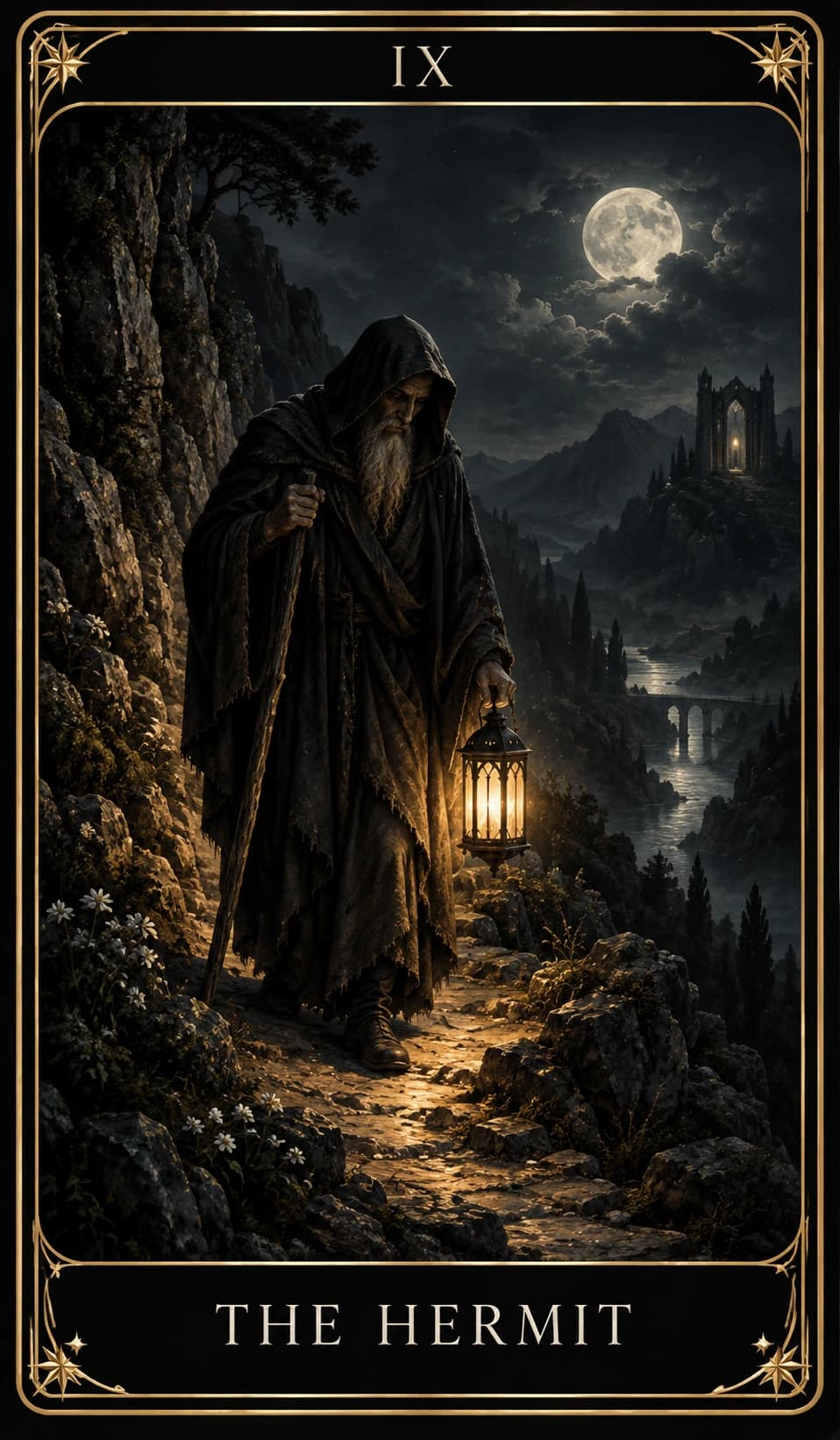
The Hermit
Some questions become clearer when the noise falls away. The Hermit asks what a deliberate pause helps you hear, and when it is time to return to the conversation.
- Reflection
- Solitude
- Inner guidance
Upright and reversed meanings, with space for your own judgement.
What does The Hermit mean?
The Hermit concerns a quieter form of attention. You may know the opinions around you so well that you can repeat them before you can describe your own response. A little distance can help distinguish what matters to you from what is expected, admired or simply said most often. The card makes room for that examination without requiring an immediate answer.
In Path of the Nine, solitude remains connected to life. Its purpose is not to become unreachable or to prove that you need nobody. It can be a short walk, a page of notes or an interval without another person's commentary. The question is what becomes easier to understand in that space, and how you bring it back into your choices and relationships.
The Hermit upright
Upright, The Hermit invites a deliberate interval of reflection. You might turn down the volume of comparison long enough to ask whether a goal still belongs to you. Or you might notice that a disagreement has become crowded with advice, while your own need remains unnamed. Stepping back can make a question more specific, rather than making it disappear.
Give the pause a purpose that fits the situation. You could examine one assumption, write down what remains unresolved or consider which part of an arrangement feels wrong. Avoid demanding a revelation. Sometimes the result is a plain sentence: you need more time, you miss a kind of work, or you have agreed to something you do not want. Such a sentence can be enough to begin the next conversation.
The Hermit reversed
Reversed, reflection may have become a room whose door stays closed. The same question is reviewed repeatedly, but nothing new enters the discussion. Another private analysis may now offer less than a conversation, a practical trial or feedback from someone who understands the circumstances. The card can also describe a period of solitude reaching its natural end.
This is not a criticism of enjoying your own company. The distinction is whether the distance helps you engage with life or makes engagement increasingly difficult. You may be protecting a thought until it feels finished, when sharing an unfinished version would help it develop. Letting someone hear part of the question does not require giving up your judgement. Returning can be gradual: one exchange, one request or one perspective alongside your own.
The Hermit in love and relationships
Space can help you recognise a need before you ask another person to meet it. You might need time after a disagreement, a little privacy or a chance to understand why an ordinary interaction affected you. Where possible, explain the pause plainly. Other people cannot necessarily distinguish useful reflection from withdrawal if the only information they have is silence.
Reversed, ask whether distance has begun to prevent a necessary exchange. You may have thought carefully about the relationship without checking an assumption with the person involved. That does not mean you must agree, disclose everything or abandon a boundary. It means that observable conversation offers information a private theory cannot. The Hermit cannot establish that somebody has stopped caring, predict separation or tell you what their silence secretly means.
The Hermit in work and everyday choices
The Hermit can bring attention to the criteria beneath a decision. A role might be impressive to others while offering little of the work you value. A busy routine might leave no interval to notice what you want to preserve. Reflection helps when it makes those criteria clearer enough to discuss or investigate.
Reversed, repeated preparation may be keeping a piece of work away from useful feedback. You might be polishing an explanation when another person needs to see the draft, or trying to solve an unfamiliar problem without asking a basic question. Consider which informed perspective would add something you cannot supply alone. The card does not determine whether to leave a job or make a particular commitment. It helps examine how you are approaching the question.
How the reading changes its meaning
In a position about what supports you, The Hermit may suggest that quiet examination is useful. In a position about a difficulty, the emphasis may be on overthinking or a reluctance to let another perspective in. The question, orientation and surrounding cards help distinguish those possibilities. Solitude is not automatically the answer simply because the image contains one person.
Alongside The Fool, you might consider whether reflection is preparing a beginning or indefinitely delaying it. Alongside The Lovers, the useful question may be how to hear your own preferences while remaining in a relationship or shared decision. These comparisons offer contrast. They do not create a fixed instruction about what any pair must mean.
Does The Hermit mean loneliness?
Not necessarily. Chosen solitude, unwanted isolation and time spent thinking are different experiences. Upright can describe a helpful reduction in noise. Reversed can ask whether that space needs contact with lived experience again. Neither orientation labels your personality or establishes a condition.
Look at the effect of the pause. Are you finding words for something that was unclear? Are you able to return with a more honest question? Or are you circling the same uncertainty without fresh information? The distinction is more useful than deciding whether being alone is good or bad.
These meanings offer a reflective lens. They cannot establish hidden thoughts, guarantee an outcome or replace professional advice.