The Nine Tarot · Major Arcana
Death
Some changes require an old arrangement to end. Death considers what you are ready to release, what you may still miss and what the transition needs.
- Transition
- Ending
- Release
Upright and reversed meanings, with space for your own judgement.
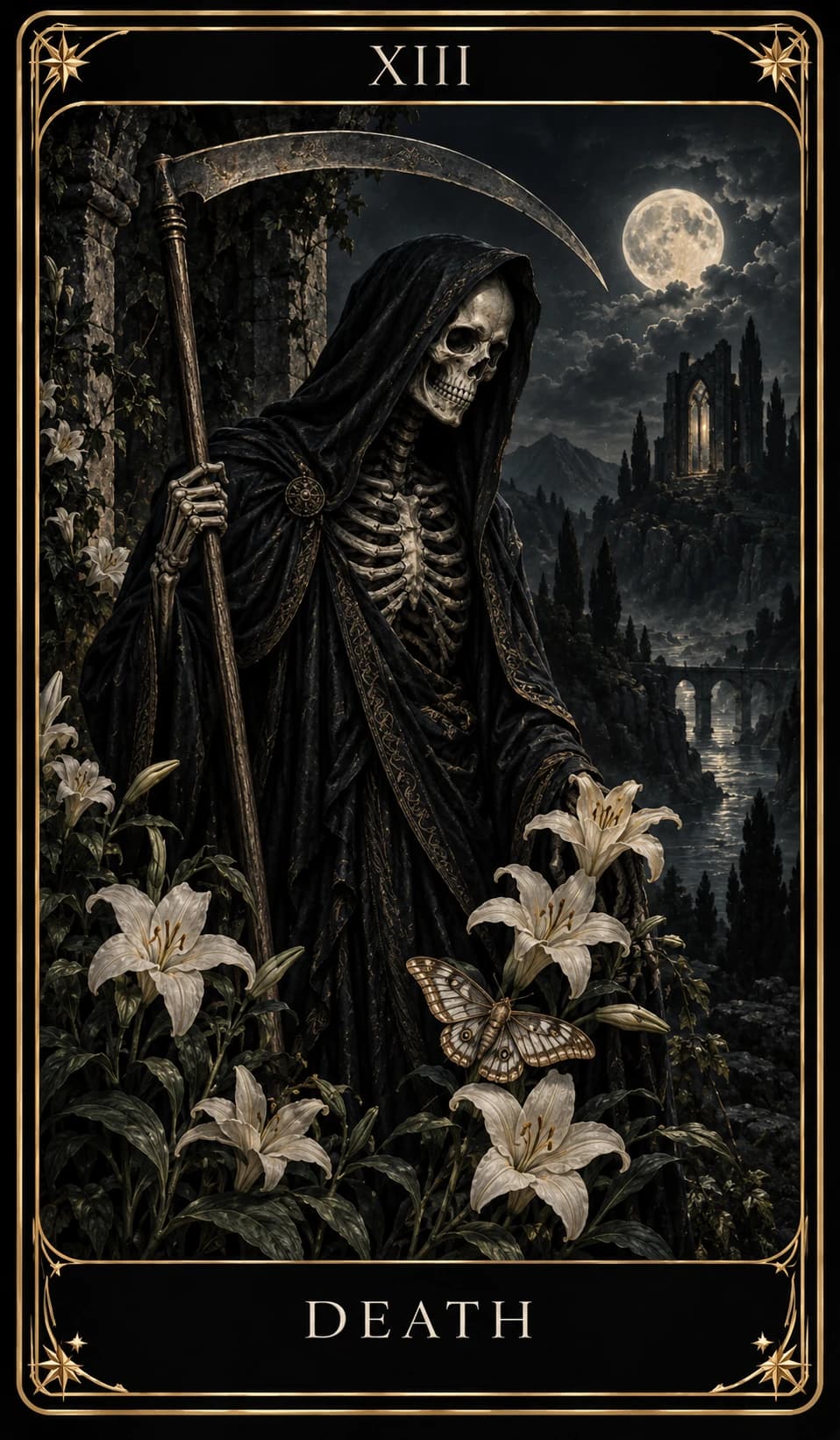
What does Death mean in tarot?
Death speaks symbolically of endings and transitions. It does not predict literal death or illness. In the Nine Tarot, the card concerns a chapter that can no longer contain the life developing around it: a method, an agreement, a role or an idea of who you are supposed to be.
An ending can be necessary and still feel difficult. Recognising that something no longer fits does not remove affection for what it once offered. The card gives both experiences room. It does not ask you to celebrate every loss, hurry a farewell or assume that whatever follows must be better.
Death upright
Upright, consider what the next stage requires you to stop carrying. A new role may need a different way of working. An established relationship may need an old pattern to end. A commitment once made willingly may belong to circumstances that have changed.
Naming the ending can make the transition more manageable. Decide what remains useful, what needs acknowledgement and what support you need while the arrangement changes. This can involve an ordinary conversation or a practical handover. The card's strong name does not make a dramatic break more appropriate than a thoughtful one.
Death reversed
Reversed, change may be gradual or a farewell may remain unfinished. You can understand that something is ending while continuing to reach for its familiar shape. A routine, title or agreement may remain recognisable long after it has stopped serving its original purpose.
Release can happen in stages. Distinguish a pace that helps you adjust from postponement that prevents adjustment altogether. You might begin with one small part of an old commitment, rather than demanding a complete departure. An unfinished transition is not a failure of character, and the card gives no deadline by which it must be complete.
Death in love and relationships
An old way of relating may need to end even when the connection continues. Perhaps one person has always organised everything, or a disagreement has been handled through silence. A different agreement can change the relationship without determining its future in advance.
Reversed, notice which conversation keeps returning because the underlying arrangement has never changed. Ask what needs to be acknowledged before another agreement can be made. The card cannot predict a separation, decide that a relationship is over or establish how another person privately feels about change.
Death in work and everyday choices
A familiar method can become unsuitable for the work ahead. You may need to stop maintaining an approach simply because you invested effort in learning it. That effort can still have value while the method changes.
With Death reversed, examine the energy spent keeping an outdated role intact. Some continuity may be useful during a transition, but it helps to identify what is temporary. Clarify what will be retained, what can be handed over and what learning the next stage requires. This is reflection on change, rather than an instruction to leave a job or make a particular professional decision.
An ending in the context of a reading
Death may describe an earlier transition, a present difficulty with release or something a possible next step would require. The Hanged Man makes room to reconsider an approach; The World considers completion and integration. Context helps distinguish a purposeful pause from a chapter whose practical ending still needs recognition.
Is Death a bad card?
It is not a verdict or a warning of catastrophe. Its subject can be uncomfortable because endings often involve uncertainty, but discomfort does not determine the value of a change. Neither orientation tells you to force an ending. Read it as an invitation to examine what is changing and how to respond with care.
These meanings offer a reflective lens. They cannot establish hidden thoughts, guarantee an outcome or replace professional advice.