The Nine Tarot · Major Arcana
The Hierophant
A tradition can offer a place to begin without deciding where you must remain. The Hierophant considers what you learn from belonging, and what still needs your judgement.
- Tradition
- Learning
- Shared values
Upright and reversed meanings, with space for your own judgement.
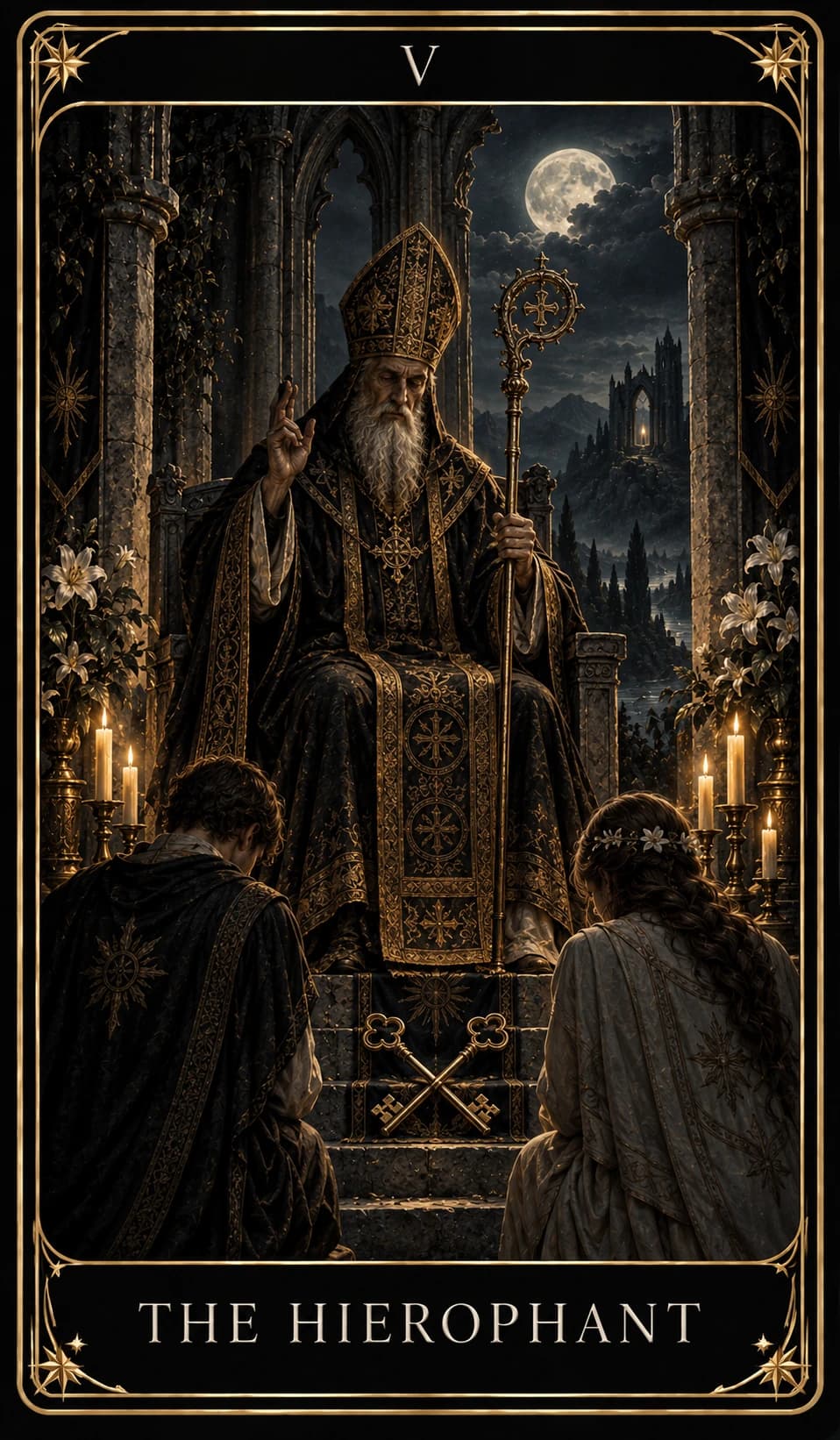
What does The Hierophant mean?
The Hierophant concerns knowledge held in common: a practice, a community, a teacher or a method that others have used before you. There can be value in learning why something is done a certain way before deciding whether to follow it.
Belonging does not require agreement with every rule. In the Nine Tarot, the card leaves room to question a respected source and revise a belief that once helped you. Its subject is the relationship between shared knowledge and personal judgement, rather than obedience for its own sake.
The Hierophant upright
Upright, an established practice may give an unfamiliar task a useful starting point. A teacher can explain what matters, a colleague can show how something works, or a community can offer language for an experience you have struggled to describe.
Good learning includes questions. You can respect experience while asking why a method is useful and where its limits lie. Consider what you want to learn before choosing a guide. A familiar title or institution does not, on its own, establish that its approach fits your circumstances.
The Hierophant reversed
Reversed, an inherited expectation may no longer fit. You might be following a model of work, family or commitment that made sense elsewhere but leaves important parts of your present life unspoken.
Questioning it becomes more useful when you can name the value beneath the rule. If a custom aims to show care, there may be another way to show it. If a process aims to preserve quality, changing it should still account for that purpose. Independent thought need not involve rejecting every guide. It can mean choosing more deliberately which ones deserve your trust.
The Hierophant in love and relationships
People bring different ideas about commitment into a connection. What feels obvious to one person may be a family custom, a previous experience or an expectation the other person has never shared.
Discussing those assumptions can make an agreement more honest. Reversed, the card may favour a form that suits the people involved, provided each can choose it freely. It cannot predict marriage or establish that a relationship should follow a particular social or religious model.
The Hierophant in work and everyday choices
A tried method can save effort when its purpose is understood. Ask someone experienced to explain the parts that matter, rather than simply copying the finished result. Learning can include knowing when to adapt.
Reversed, distinguish a process that serves the task from one preserved because nobody has questioned it. A departure becomes easier to assess when you can explain what improves and what still needs protecting. Change need not be dramatic to be principled; a thoughtful adjustment can retain valuable knowledge while removing an unnecessary constraint.
Tradition in the context of a reading
The Hierophant can represent support through learning or pressure through conformity, depending on the question and position. The Lovers brings personal values into view; The High Priestess gives your own response room to become clear. Together, these themes can help you consider what you inherit and what you choose.
Does The Hierophant require conformity?
No. Shared practice and independent thought are both part of this card's authored meanings. Upright does not make an institution beyond question, and reversed does not make every departure wise. Understand what a rule provides, what it costs and whether its purpose can be honoured in a different way.
These meanings offer a reflective lens. They cannot establish hidden thoughts, guarantee an outcome or replace professional advice.